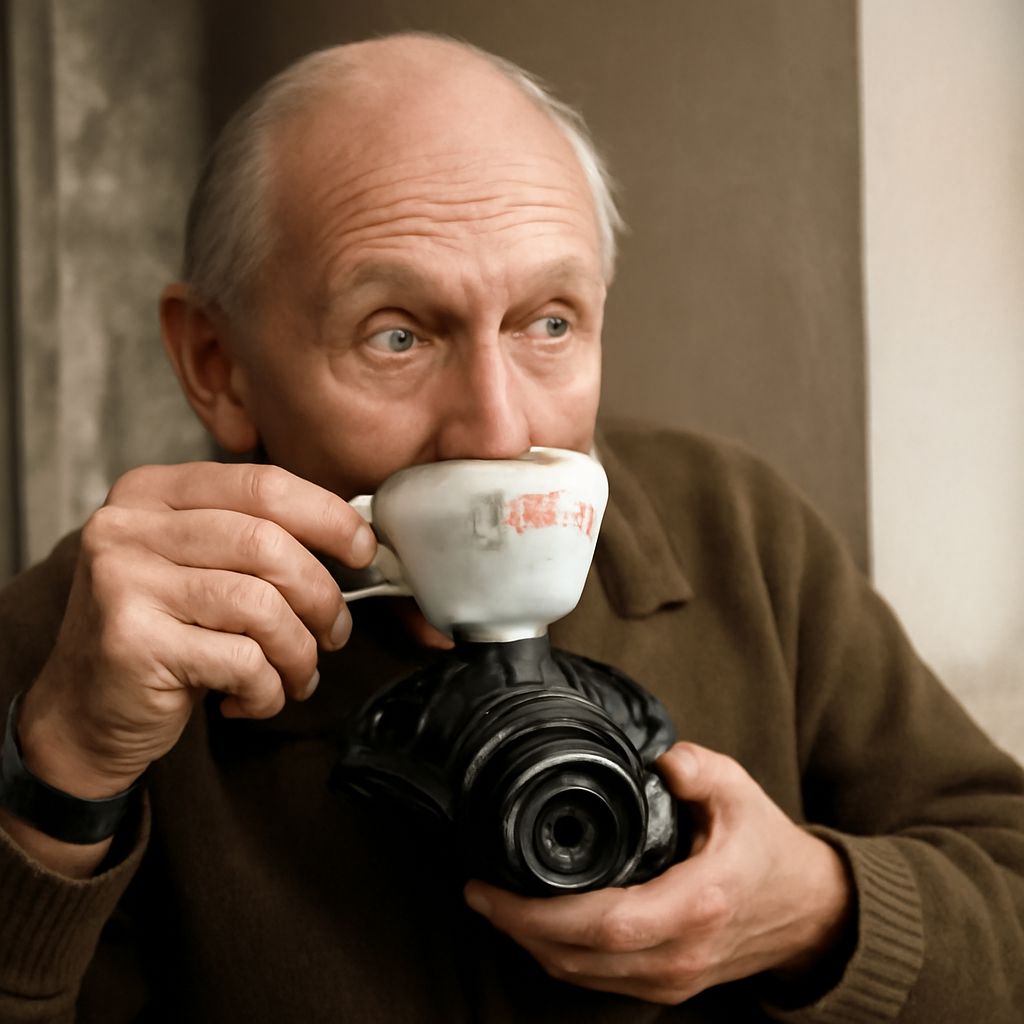
Street photography is the practice of observing and photographing unscripted public life, usually without a predetermined story to report. Its subject may be a gesture, encounter, pattern, contradiction, or quiet moment that gains meaning through the photographer’s attention rather than through an assignment.
Journalistic photography can also be candid and made in public, but it serves a different purpose: documenting a reported event, issue, or situation for an audience that needs context. The same image can resemble both fields, yet its purpose, preparation, captions, and surrounding reporting determine how it functions.
What Is Street Photography?
What is street photography? In practical terms, it is open-ended visual observation in a public or publicly accessible setting. The photographer goes out to notice relationships between people, architecture, light, movement, and chance. The resulting photograph does not need to explain a complete event. It can preserve an ambiguous moment and allow viewers to form their own interpretation.
“Street” does not mean the picture must be made on a literal road. A market, train station, bus, park, shopping centre, beach, or community gathering can all provide the setting. The defining feature is the approach: the photographer responds to unscripted public life instead of directing a scene or illustrating a preselected news angle.
That approach still involves deliberate choices. A street photographer decides where to stand, when to raise the camera, how close to work, and whether a passing arrangement has enough visual or human tension to justify a frame. A candid portrait made as part of a commissioned profile may look like street work, but its assignment and intended story place it closer to editorial or journalistic practice.
Journalistic Photography: Purpose, Context, and Reporting
Journalistic photography uses photographs to report something that matters beyond the individual frame. Its subject might be an election, a flood, a court hearing, a labour dispute, a community, or the consequences of a public decision. The photographer works with a question, assignment, or news development and supplies images that help an audience understand what happened, who was affected, and when or where it occurred.
Context is therefore central. Captions, dates, locations, names, sequencing, and accompanying text can be as important as composition. Journalistic standards also place weight on accuracy and transparency: a photograph should not mislead viewers about the event, and significant manipulation or staging can undermine its reporting function.
Consider a picture of people running through a city street. If the photographer noticed an expressive, visually layered moment while making an open-ended walk, it may be street photography. If the runners are escaping a documented fire and the image is published with verified details about the incident, it is journalistic photography. The visual appearance may be nearly identical; the purpose and context are not.
Henri Cartier-Bresson Street Photography: Timing and the Decisive Moment
Henri Cartier-Bresson remains a key reference because he showed how candid observation could produce photographs with both spontaneity and formal control. His work is associated with the “decisive moment”: the brief instant when gesture, expression, movement, and circumstance align into a particularly meaningful composition.
The idea is not simply to react quickly. It requires sustained observation and a readiness to recognise potential before it fully appears. Cartier-Bresson often anticipated how people would move through a space, then waited for a position, gesture, or interaction to complete the visual structure.
Composition was inseparable from timing. Diagonals, windows, steps, shadows, repeated shapes, and empty space could organise a chaotic public scene. A person entering the frame at exactly the right point might balance an architectural form; a turned head might connect two otherwise separate figures. This geometry gives a candid photograph clarity without making the event feel staged.
His influence is especially useful as a working method: observe first, simplify the frame, and release the shutter when the relationships are strongest. The goal is not to imitate his locations or monochrome style. It is to develop patience, visual anticipation, and respect for the unpredictable behaviour that gives street photographs their life.
What to Look for in a Street Photograph: Boundaries and Examples
A strong street photograph usually offers more than proof that someone was present. Look for a relationship between people and their surroundings, a revealing gesture, a tension between private emotion and public space, or a pattern that chance has briefly completed. Light and colour can guide attention, but an unusual subject alone does not make an image successful.
- Street photography: A cyclist pauses beneath a billboard, aligning with its oversized figure. No public event is being documented; the interest lies in the fleeting visual and thematic connection.
- Journalistic photography: Residents receive emergency supplies after a documented storm. The image supports reporting about the disaster, and its caption identifies the place, date, people, and circumstances.
- Both fields: A photographer makes a candid image during a public demonstration. As an isolated observation of gestures, signs, and crowd movement, it can operate as street photography. Published with verified information about the protest’s demands and consequences, it also becomes part of journalistic coverage.
To classify a borderline image, ask what the photographer was trying to do and what information the audience needs from it. An open-ended observation can remain suggestive and unresolved. A reported photograph must connect the moment to a factual account. That distinction keeps street photography and journalistic photography related, but not interchangeable.