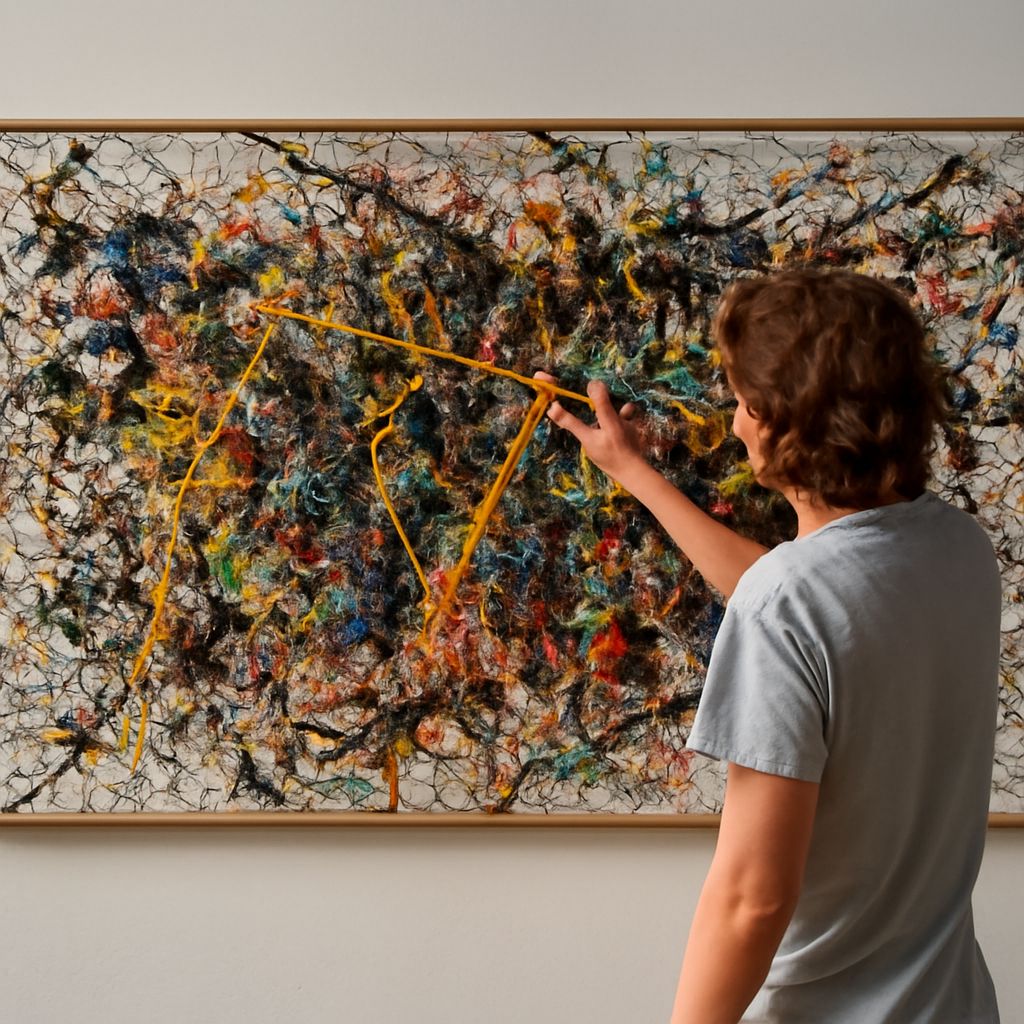
Jackson Pollock, a name synonymous with innovation in the world of modern art, is celebrated for his unique splatter painting technique. Known as a pivotal figure in the abstract expressionist movement, Pollock’s art style broke the conventions of his time and continues to influence artists today. This exploration delves into Pollock’s signature approach, his technique, and the lasting impact of his work.
Understanding Jackson Pollock’s Art Style
Jackson Pollock’s art style is characterized by its vibrant energy and chaotic patterns. He pioneered a method known as “drip painting,” where paint was poured or splattered onto canvas laid flat on the ground. This technique allowed Pollock to engage directly with his work in a physical and dynamic way, creating complex layers of color and texture that appear both spontaneous and meticulously crafted.
Pollock’s approach marked a significant departure from traditional painting methods that relied on brushwork and easels. Instead, he embraced an unorthodox style that emphasized the process of creation itself. This resulted in works that embodied motion, rhythm, and intensity, captivating viewers with their raw expression and boldness.
The Technique Behind Pollock’s Splatter Paintings
The technique behind Pollock’s splatter paintings involves a fascinating interplay of control and chance. By using sticks, syringes, and hardened brushes to fling or drip paint, Pollock created intricate webs of color. The method allowed him to incorporate the element of unpredictability, making each artwork a unique exploration of form and motion.
Pollock often used industrial paints such as alkyd enamel, which provided a glossy finish and rich color depth. His choice of materials and tools was integral to achieving the desired visual effect, as the fluidity of the paint enabled it to spread and intersect in complex ways. The resulting artworks are textured and layered, inviting viewers to explore the nuances within the chaos.
Influence and Legacy of Jackson Pollock
Jackson Pollock’s influence extends far beyond his lifetime, shaping the trajectory of contemporary art. As a splatter paint artist, Pollock challenged the conventions of what constituted art in the mid-20th century. His works paved the way for future abstract artists to experiment with form and materials, encouraging a break from tradition.
Pollock’s legacy is evident in the continued admiration and study of his techniques by artists and scholars alike. His approach has inspired numerous art movements and has been referenced in various cultural expressions, including music and literature. The impact of Pollock’s work can also be seen in the way art is valued and perceived, emphasizing the importance of creative freedom and innovation.
Answering: Who Is Jackson Pollock?
So, who is Jackson Pollock? Born in 1912 in Cody, Wyoming, Pollock became one of the most influential figures in American art. After studying at the Art Students League in New York, he was introduced to the works of Mexican muralists and European surrealists, which influenced his early style.
Pollock’s rise to fame came in the late 1940s when his drip painting technique garnered widespread attention. He was dubbed “Jack the Dripper” by Time magazine, and his work rapidly gained acclaim in the art community. Despite personal struggles and a turbulent life, Pollock’s contributions to art were profound, leaving an indelible mark on the artistic landscape.
Jackson Pollock passed away in 1956, but his art continues to be celebrated for its daring originality and expressive power. As a luminary in the world of modern art, Pollock remains a central figure in discussions about creativity and the evolution of artistic expression.