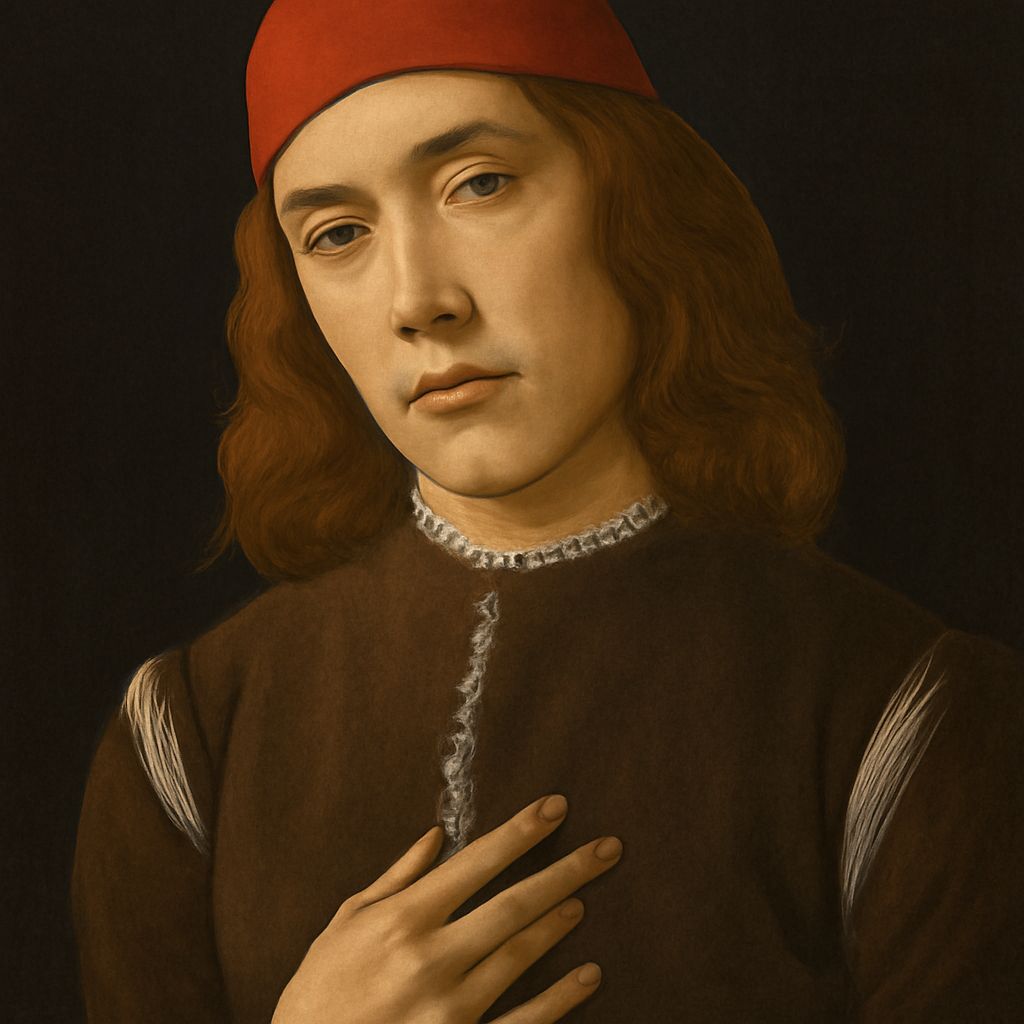
In a crowded painting of the Magi, one young man seems to have noticed the viewer. He stands at the far right, wrapped in a golden garment, and looks outward rather than toward the central event. The figure is a possible self-portrait by Sandro Botticelli, identified in the Uffizi Galleries’ account of its Adoration of the Magi; the identification is persuasive enough to invite a closer look, but remains a proposal.
Sandro Botticelli Self Portrait: Where to Look
Open the Uffizi’s page for Adoration of the Magi and locate the Virgin and Child near the center. The visitors cluster around them, some kneeling and others standing in conversation. Follow the group to the painting’s right edge. There, a fair-haired young man turns his face toward the viewer, his golden cloak forming a broad, bright shape against the darker clothing nearby.
The museum dates the work to 1470–1475. It was made for the chapel of Gaspare di Zanobi del Lama in the Florentine church of Santa Maria Novella. The Sandro Botticelli self portrait candidate is part of this larger religious scene, rather than the sole subject of a separate portrait. That setting makes his position at the edge especially easy to miss when attention is fixed on the Holy Family.
What Supports the Identification?
The Uffizi says Botticelli may have included himself as the young blond man at right. It points to his outward gaze as a pose that recurs in painters’ self-portraits. The effect is immediate: among figures absorbed in the gathering, this man appears to meet the viewer’s eyes. His glance offers a small passage between the painted space and the room in which the picture is being seen.
That visual clue supports an interpretation; it is not a signature on the figure. The gaze can be observed directly, while the claim that the face belongs to the painter requires historical interpretation. The museum’s wording preserves that distinction. A reader considering Sandro Botticelli’s possible portrait of himself can see the pose and understand the argument without treating the identification as certain.
This possible self-portrait in Botticelli’s painting stands among figures understood as members of the Medici family and their circle. The Uffizi presents several of those identifications with qualifications as well. The sacred event and recognizable Florentine society share the same picture, so the proposed appearance of the artist belongs to a scene already rich in portraits and allusions to its patrons.
A Portrait Within a Story
Botticelli’s possible self-portrait at the edge works differently from a solitary likeness. The viewer must first find the figure, then decide how his glance relates to the rest of the scene. The golden garment gives him visual weight, but the direction of his eyes gives him a different role from the kneeling visitors. He is inside the event and seems aware of someone outside it.
For a photographer studying the image, that distinction offers a way to think about group portraits. A face looking into the lens can establish a relationship with the viewer, while others looking elsewhere can keep attention moving within the frame. The meaning comes from the arrangement of all those gazes, not from eye contact alone.
Is this the only painting called Adoration of the Magi by Botticelli? No. The National Gallery of Art’s painting of the same subject is a different work. To find the proposed likeness of Botticelli discussed here, look for the Uffizi panel and the outward-looking figure at its right edge.