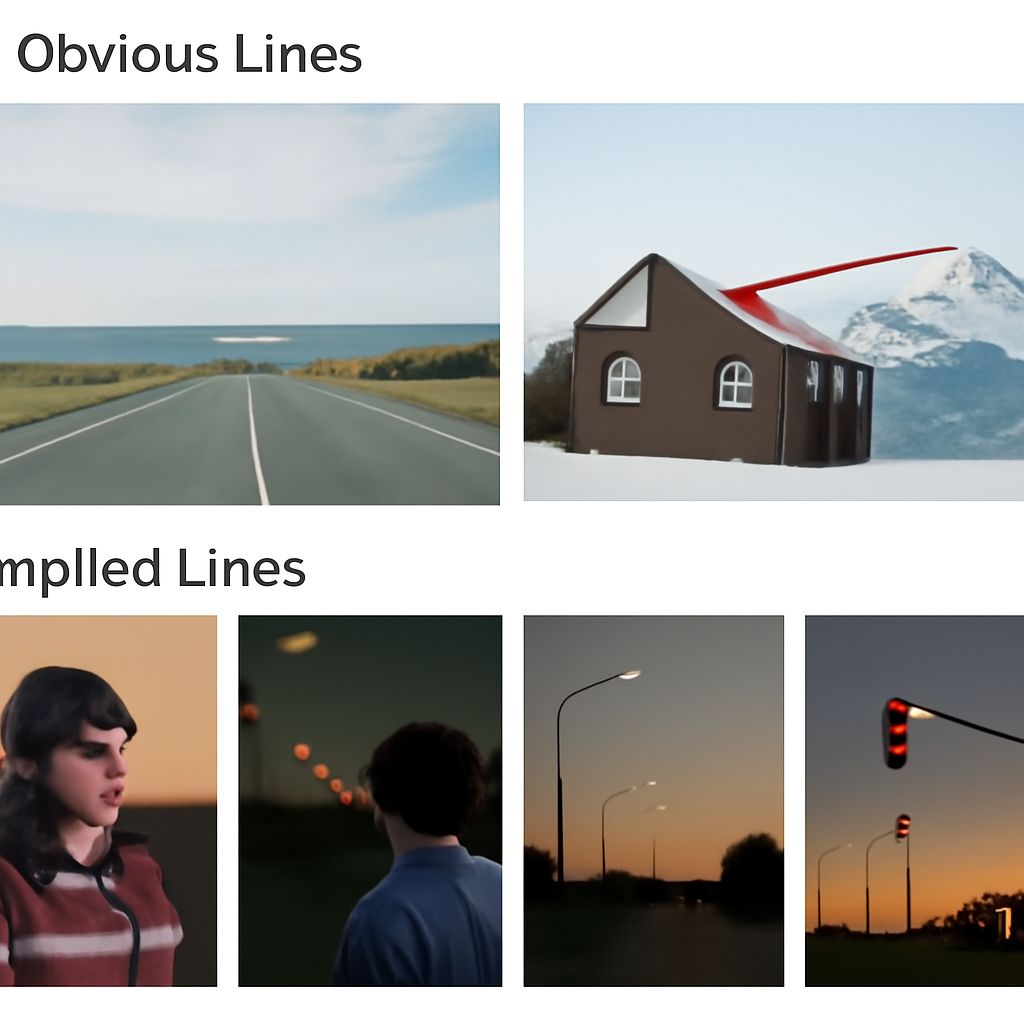
In photography, form is the appearance of three-dimensional volume in a flat image, while line is a visible edge or visual path that directs attention. Light, shadow, perspective, and overlap make form feel solid; edges, alignments, and repeated directions make line organize the frame.
Use form to create depth and weight, and use line to control how the viewer moves through the photograph. The strongest compositions usually make these elements work together rather than treating them as separate effects.
Form as an element of art in a flat image
A practical form as an element of art definition is a shape that appears to have volume, mass, or depth. A shape is flat and two-dimensional: the silhouette of a person, a circle on a wall, or the outline of a leaf. Form suggests what exists behind that outline.
For example, a front-lit apple may appear mostly circular, but side light reveals its curve through a bright highlight and a gradual shadow. A portrait becomes more sculptural when light models the cheekbones, nose, and jaw. A building photographed from an angle gains form because its visible planes show depth and relationship.
Light is the primary tool for creating this impression. Side lighting emphasizes texture and volume; soft, frontal light reduces modeling; backlighting often turns an object into a flat silhouette. Perspective adds another cue. Showing several planes of a box, overlapping objects, or making nearer forms larger than distant ones helps the viewer read depth on the image plane.
How actual, implied, and converging lines create direction
Line as an element of art can be literal or suggested. An actual line is visibly drawn by an object or edge: a railing, road marking, horizon, tree trunk, or the border between light and shadow. Its direction can feel calm when horizontal, stable when vertical, or energetic when diagonal.
An implied line is not physically drawn but is created by relationships. A row of people looking toward one subject, a dancer’s extended arm, or a sequence of bright windows can lead the eye along an invisible path. Gaze direction and repeated forms are especially effective implied lines because viewers naturally connect them.
Converging lines are actual or implied lines that appear to meet in the distance. Railroad tracks, road edges, and rows of buildings create perspective toward a vanishing point. Place the important subject near that destination to make the convergence purposeful, or keep it away from the vanishing point when you want the eye to travel through the entire scene.
Photo composition rules built from line and form
- Rule of thirds: Place a strong edge, horizon, or vertical form on a third rather than automatically centering it. Position a face, doorway, or brightest volume near an intersection so the line and subject reinforce each other.
- Leading lines: Follow roads, shadows, fences, or architectural edges toward the main form. Check where the line begins, where it ends, and whether it exits the frame before reaching the subject.
- Framing: Use an arch, window, branch, or dark foreground shape to surround the subject. The frame’s edges contain attention while contrast between foreground and subject can increase the subject’s apparent depth.
- Layering: Build foreground, middle-ground, and background forms with overlap and changing scale. A nearby textured object can supply a strong line or edge, while smaller distant forms establish depth behind it.
When to bend the rules for a stronger frame
Composition rules are useful starting points, not requirements. Center a form when symmetry, stillness, or a direct confrontation is the subject. Let a horizon divide the frame evenly when the relationship between sky and land matters more than off-center balance. Allow a leading line to leave the image when the intended effect is movement beyond the frame.
Break the rule of thirds when a centered line makes reflection or architecture cleaner. Break conventional perspective by tilting the camera when converging edges should feel unstable. Before changing the frame, identify the dominant line or form and decide whether the deviation strengthens its direction, volume, or visual relationship with the surrounding space.