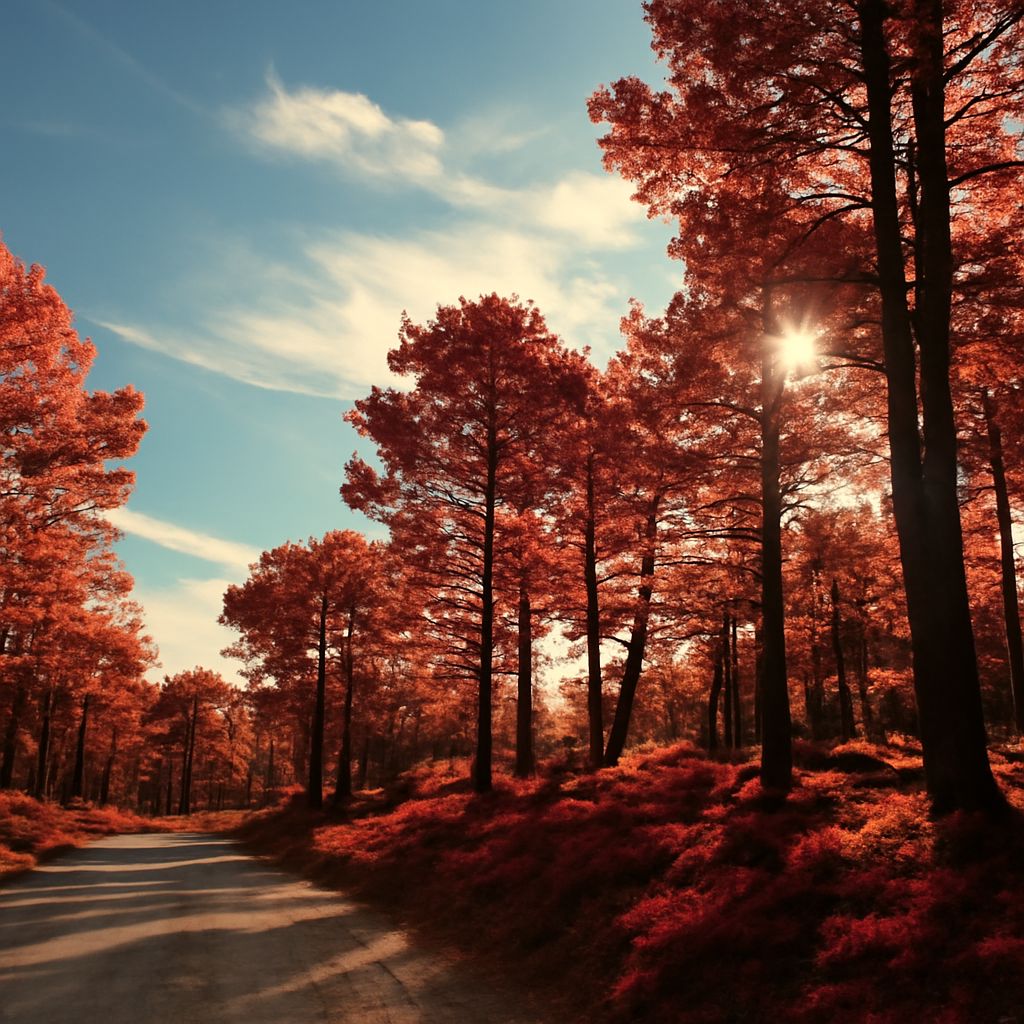
A tree can appear pale against a dark sky in an image made with near-infrared light. Photographing in IR reveals a response to wavelengths just beyond visible red, giving familiar landscapes a different tonal structure. The result depends on the camera, filter, light, and processing choices behind the frame.
IR Photography and Near-Infrared Light
Leaves reflect much near-infrared light, so foliage may appear bright in a monochrome image. A clear sky can appear dark, making branches stand out. This contrast is often called the Wood effect. Water, clouds, and buildings respond differently, so a landscape with several materials offers more to compare than a frame filled with leaves alone.
Near-infrared photography usually records reflected light, often sunlight. Thermal imaging uses longer infrared wavelengths and different sensors to show radiation associated with temperature. A pale tree in a near-infrared picture is therefore not a temperature map; its brightness reflects the interaction of illumination, material, filter, and sensor.
Choose a camera and filter
Most ordinary digital cameras have an internal filter that blocks much infrared light. Some still admit enough for an external infrared filter on the lens, but exposure times and results vary by model. Before buying a filter, check examples or specifications for the particular camera and lens. A filter that passes wavelengths from around 720 nanometers is a common starting choice, although the camera’s response and the filter’s transmission determine what reaches the sensor.
When photographing infrared scenes with an unmodified camera, the dark filter and internal blocking can mean long exposures. A tripod and a still subject help; moving leaves can blur while the shutter remains open. Some camera-and-filter combinations admit too little light to be practical. Test in daylight and inspect the result rather than assuming that all cameras will behave alike.
To make infrared images, a conversion service can replace the internal blocking filter with a filter chosen for infrared work. A converted camera can often use shorter exposures, but the conversion changes how the camera records ordinary visible-light scenes. A full-spectrum conversion is another option and requires suitable external filters to select the desired wavelengths. Compare the service’s options and costs before committing a camera to conversion.
Focus, expose, and set white balance
Infrared light may focus at a different point from visible light. With a dark external filter, compose and focus before attaching it if the view becomes too dim; then make a test exposure and inspect fine detail at magnification. Live view focusing with the filter in place may work on some cameras. A converted camera’s focusing behavior depends on its design and setup, so test the particular combination rather than relying on a universal correction.
For IR photography, begin with a stable camera and a test exposure, then adjust shutter speed or ISO until the subject retains detail in both bright foliage and darker surroundings. The meter may not predict the result accurately through a strong filter. Review the histogram, a graph of recorded brightness, and watch for highlights piled against the right edge, where detail may be clipped.
White balance changes how recorded channels are rendered. A custom setting made for the filtered scene, if the camera supports it, can provide a more manageable starting image. Saving raw files preserves more flexibility for adjusting the rendering later; some editors or cameras may limit the available white-balance range. Take a test frame and check what the chosen software can interpret.
Decide how to render the image
An infrared photograph can be converted to black and white, where pale foliage and a darker sky become a study in shape and contrast. Alternatively, a false-color image assigns or rearranges recorded channel information to create a palette that may include blue skies or unusual foliage. These colors are an interpretation of the captured data, not the colors a person would see at the scene. Different filter cutoffs and sensor responses produce different starting information, so a preset from another camera may need adjustment.
Choose a sunny scene with foliage and sky, then check whether the camera model can record near-infrared light through an external filter before selecting equipment for a first test.