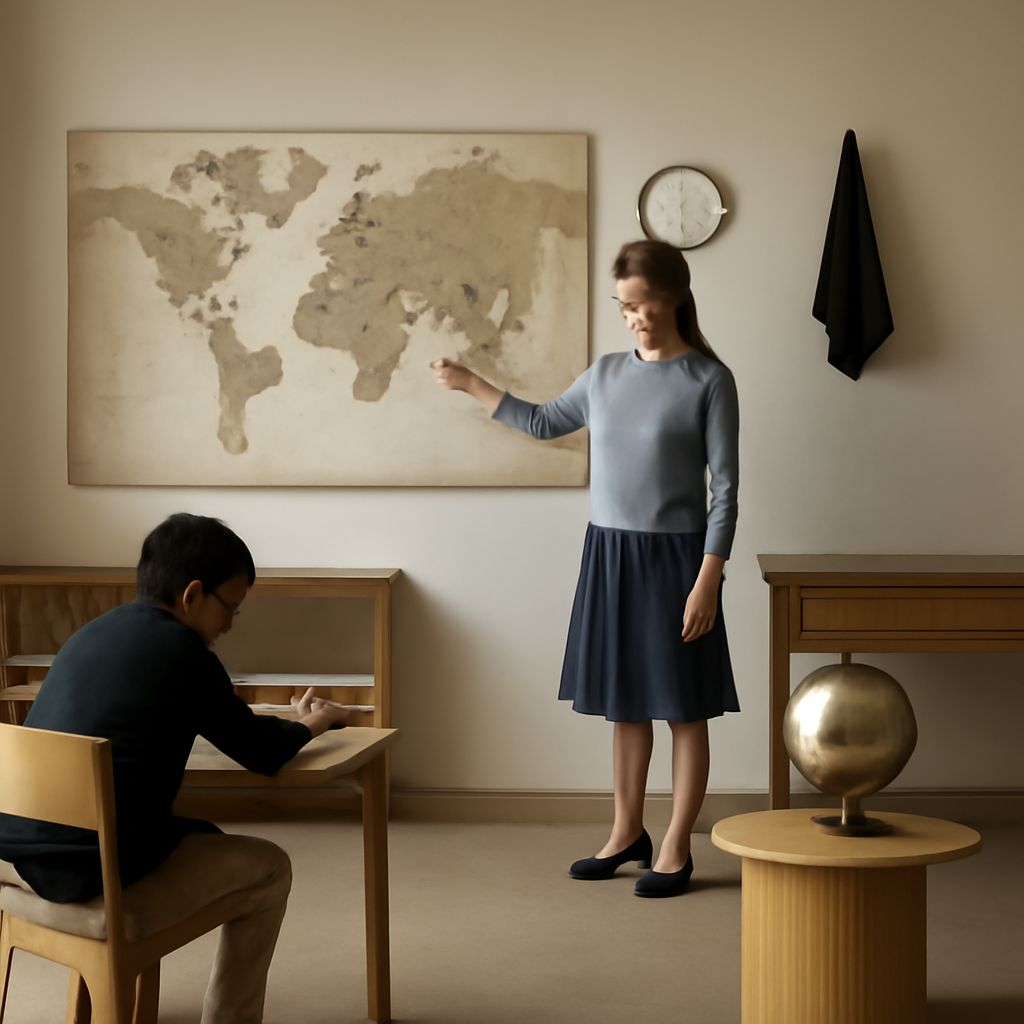
The main shapes in a painting give the image its basic structure and help determine how the eye reads it. Geometric, organic, positive, negative, actual, and implied shapes can establish balance, emphasis, depth, and a directional path through the composition.
These effects become clearer when shape is considered alongside the laws of perceptual organization. Gestalt principles explain why viewers group certain forms, separate others, and follow visual connections across a painting.
Main Shapes in a Painting: Geometric, Organic, Positive, and Negative
Geometric shapes have regular, measurable qualities: circles, squares, triangles, rectangles, and straight-edged polygons. They often suggest order, stability, machinery, or architecture. Piet Mondrian’s grids, for example, rely on rectangles and lines to create a controlled visual structure.
Organic shapes are irregular and usually resemble forms found in nature, such as leaves, clouds, stones, bodies, or flowing water. Their uneven contours can make a painting feel more natural, relaxed, or dynamic. A landscape may combine geometric shapes in buildings with organic shapes in trees and hills.
Positive shapes are the forms that occupy attention, such as a person, vase, or mountain. Negative shapes are the surrounding or enclosed areas of space. In a still life, the gap between a handle and a cup is a negative shape; its size and contour can be as important as the object itself. Strong compositions treat positive and negative shapes as interdependent parts of one design.
Actual and Implied Shapes in Painting
An actual shape is visibly enclosed by a boundary, such as a painted circle, a figure’s silhouette, or a block of color. Its edge may be sharp, soft, dark, or barely contrasted, but the shape is directly present on the surface.
An implied shape is suggested rather than completely outlined. Several figures may face the same point, causing the viewer to perceive a triangular arrangement even when no triangle is drawn. Similarly, separated marks can imply a circle when their positions and curves lead the eye around an empty center. Implied shapes let artists organize space without making every boundary explicit.
Laws of Perceptual Organization: Proximity, Similarity, Continuity, Closure, and Figure-Ground
The laws of perceptual organization describe common ways the eye groups visual information:
- Proximity: Forms placed close together appear related. A cluster of small marks may read as one group, while a larger gap separates it from another group.
- Similarity: Shapes with matching color, size, contour, or texture are perceived as belonging together. Repeated red circles can connect scattered areas of a composition.
- Continuity: The eye prefers smooth, uninterrupted paths. A row of fence posts, a riverbank, or a curved arm can guide attention along a line rather than stopping at each individual form.
- Closure: Viewers mentally complete incomplete forms. A broken outline can still read as a face, arch, or circle if enough of its structure is suggested.
- Figure-ground: The eye separates a dominant figure from its surrounding field. Contrast, scale, overlap, and sharpness can make one shape read as the figure while another becomes the ground.
These principles work together. Similar marks placed near one another may form a figure, while continuity connects that figure to a second area. Ambiguous figure-ground relationships can reverse attention, making the negative space briefly appear to be the subject.
Definition of Movement in Art: How Grouping Creates a Viewing Path
A practical movement in art definition is the visual direction or flow that leads a viewer’s attention through a composition. It differs from literal motion: a painted runner does not physically move, but diagonals, repeated shapes, gestures, and changing intervals can make the body appear to advance.
Grouping creates movement by giving the eye connected steps. Proximity can form a chain of objects; similarity can repeat a color from foreground to background; and continuity can turn a road, contour, or gesture into a visual route. Overlapping shapes create depth, encouraging the eye to move from the front form toward those behind it. Graduated scale can produce another path, as repeated shapes shrink toward the distance.
Direction also matters. Diagonal geometric shapes tend to feel more active than horizontal ones, while curved organic shapes can create a slower, sweeping rhythm. A painter might place a bright positive shape near the lower edge, repeat its color through the middle ground, and finish with a small implied shape near the horizon. The resulting sequence uses grouping to guide the eye without requiring literal arrows or motion lines.