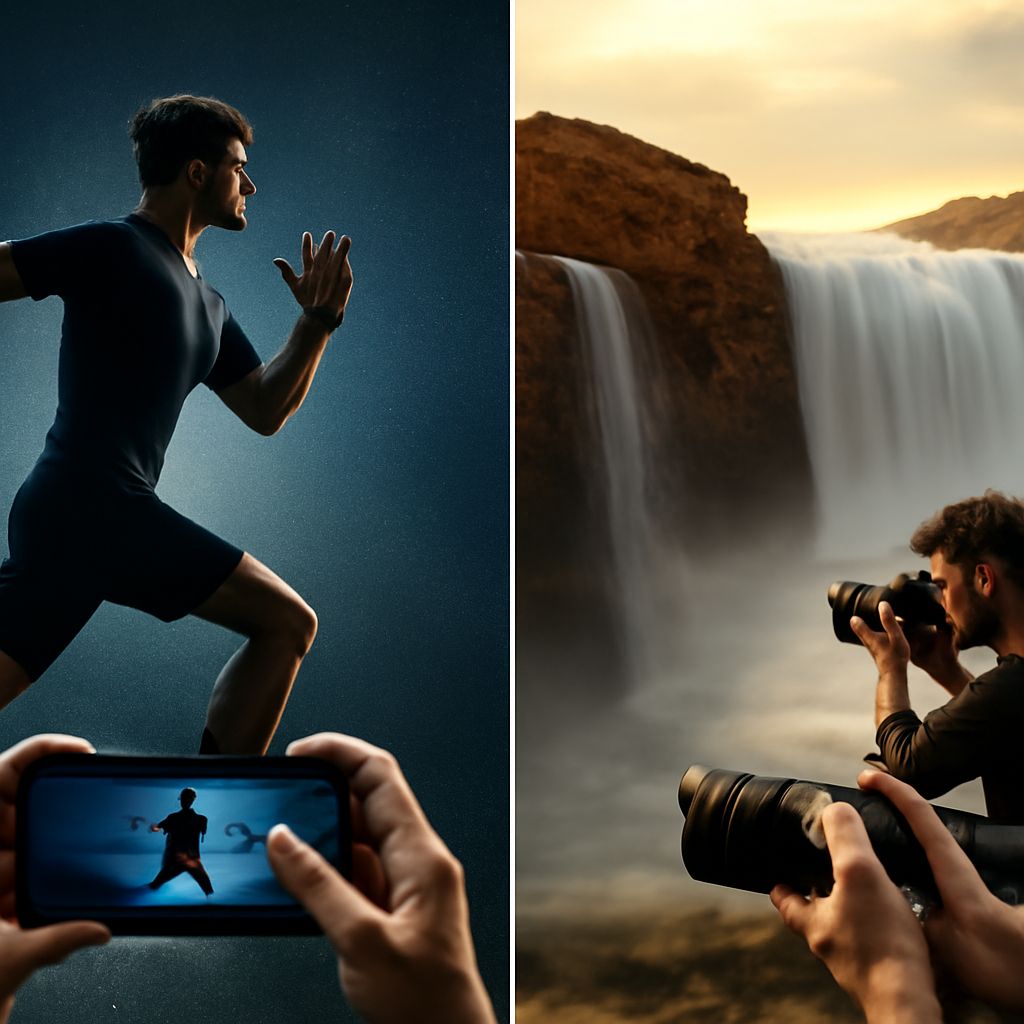
A cyclist passing a row of trees can become a crisp figure suspended in an instant or a streak of color against a steady landscape. Both photographs show movement, but each asks the viewer to notice something different. The choice begins with what should remain recognizable: the rider, the surroundings, or the path between one moment and the next.
Freeze a moment
To capture movement in a photograph, a short shutter speed limits how far the subject travels during an exposure. Start around 1/1000 second for a cyclist and adjust after reviewing the result. The speed needed depends on how fast the subject crosses the frame, its distance, and the direction of travel. A person moving across the camera’s view generally covers more of the frame than one approaching from far away.
Use continuous autofocus to follow the subject, and place the focus area over a meaningful detail such as the rider’s face. A higher ISO or wider aperture may be needed to maintain the fast shutter speed in low light. Check the image at magnification: a sharp wheel may be satisfying, but an out-of-focus face can draw attention away from the action.
Let the subject blur
For a different treatment of motion in photography, keep the camera steady and use a longer exposure. A tripod helps keep buildings or trees recognizable while the moving cyclist becomes a soft shape. Try 1/15 second as a starting point, then vary the time to see how much of the rider remains visible. If the background is too bright at that setting, reduce ISO or use a narrower aperture.
A trace of shape can carry more information than an indistinct smear. The curve of a helmet or a recognizable wheel gives the eye something to follow. In a photograph of moving water, the same choice applies: a brief blur may preserve individual ripples, while a longer exposure can turn them into a smooth surface. Photographing movement means deciding which details serve the image.
Pan with the subject
Panning means turning the camera to follow a moving subject during the exposure. If the camera follows the cyclist at a similar speed, the rider can remain comparatively clear while the background stretches into lines. Begin around 1/30 second, track the rider before pressing the shutter, and continue the movement afterward. Continuous shooting can offer several frames with slightly different timing.
The effect takes practice: the rider’s legs and wheels may move differently from the torso, and an uneven camera movement can soften the whole figure. Use a background with color or texture so the blur has something to reveal. Compare frames for a readable face or body and a background that suggests direction without overwhelming it. This way of showing motion in photographs places the subject and the surroundings in a dynamic relationship.
Use a sequence
A series can show what a single frame leaves out. Photograph a dancer beginning a turn, reaching its peak, and coming to rest, then arrange the images in order. Keep a consistent viewpoint or a recurring element so viewers can follow the change. A fast shutter can preserve each position; a slower one may make the gestures flow between frames.
When comparing photographic movement studies, look beyond sharpness. Does the arrangement explain where the action begins and ends? Does a blurred limb add energy while leaving the dancer identifiable? Remove frames that repeat the same information, and keep those that advance the sequence.
Motion in photography becomes a question of emphasis. Choose a fast shutter when expression or form must be sharp; steady-camera blur when the setting should stay clear; panning when the subject should stand out against a streaked background; and a sequence when the change between positions is the story.