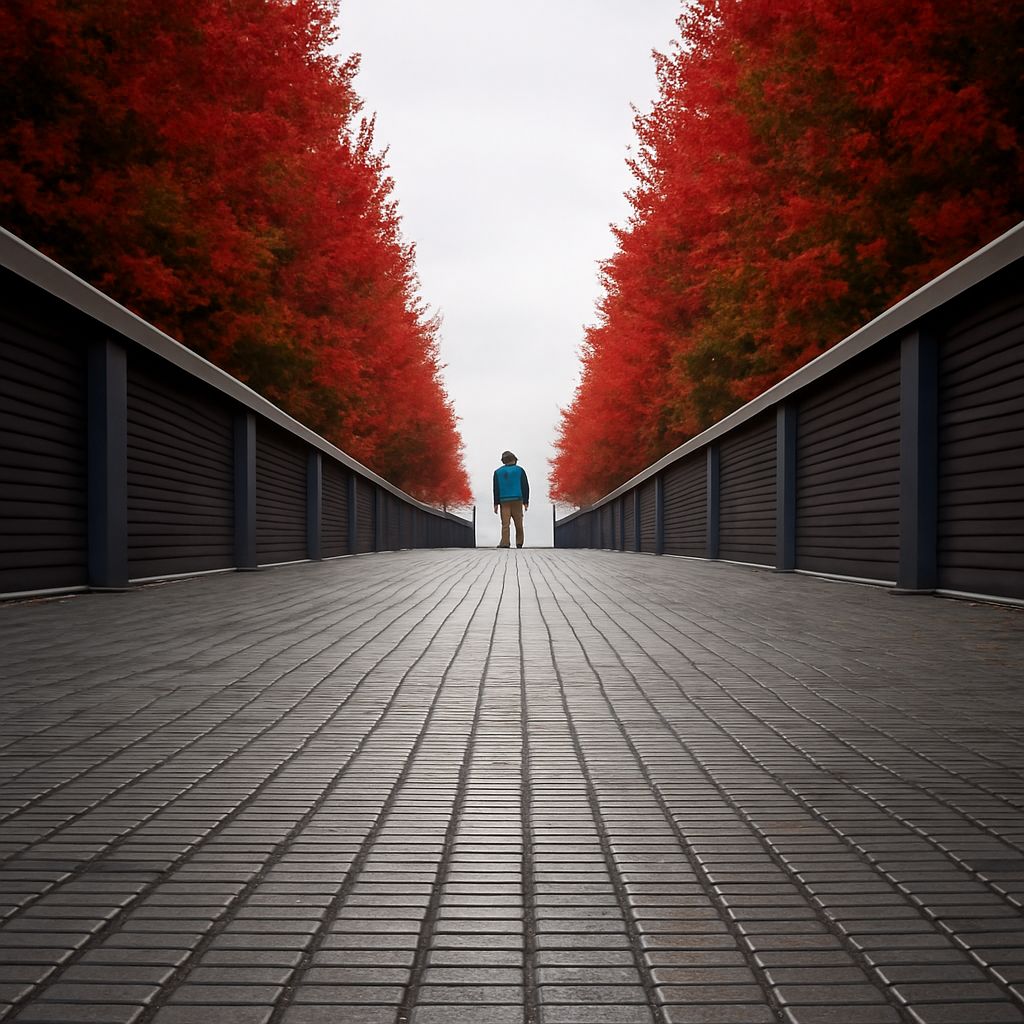
Photo perspective is the relationship between the camera, the subject, and the surrounding space. Although a photograph is flat, viewpoint, convergence, overlap, and scale can make objects appear near, distant, large, or small. A strong composition uses these cues together rather than relying on a single dramatic effect.
To construct depth, decide where the viewer should enter the frame, what should hold attention, and how foreground, middle ground, and background will connect. Lines create visual direction, while positive shapes give that direction weight and structure.
What Changes Photo Perspective?
Camera position changes perspective most directly. Lowering the camera can make a foreground object dominate the frame and cause vertical structures to tower upward. Raising it reveals more surfaces and often clarifies how shapes overlap. Moving closer exaggerates the size difference between near and distant subjects; moving farther away compresses those relationships.
Lens choice affects the angle of view and framing, but it does not replace a change in viewpoint. A wide-angle lens can include more foreground and emphasize converging edges, while a longer lens can isolate distant layers and make them appear closer together. Keep the camera position in mind when comparing these effects.
Use a doorway, bridge, or street corner as a fixed reference. Photograph it from eye level, then from a low and high position. Notice how the foreground expands, how the horizon shifts in relation to the subject, and how visible surfaces change. These differences are practical examples of perspective, not merely changes in magnification.
How Lines in Photography Create Direction and Depth
Actual lines are visible marks or edges: road markings, rails, fences, cables, architectural seams, and the horizon. They can point toward a subject, divide the frame, or lead the eye toward a vanishing point. Parallel lines that recede appear to converge, giving the viewer a clear sense of distance. Place the main subject near the area where the lines aim, unless you deliberately want a more unsettled composition.
Implied lines are not physically drawn. A person’s gaze, a row of repeated objects, a bent arm, or a sequence of bright shapes can create the same directional pull. Implied lines are often subtler than actual ones, so check whether they support the subject or send attention out of the frame.
In lines in photography, direction also carries mood. Diagonals suggest movement, verticals add height and stability, and horizontals feel calm. Avoid letting several strong lines compete for different destinations. Crop, shift your viewpoint, or reduce empty space so the dominant path remains readable.
Positive Shapes and the Surrounding Space
Positive shapes are the occupied forms in an image: a person, tree, building, rock, vehicle, or distinct patch of tone. They organize the frame by giving the eye recognizable masses to compare. The surrounding unoccupied area is negative space. It can isolate a shape, show its direction of movement, or provide visual breathing room.
Overlap is one of the fastest ways to establish spatial order. If a foreground shape covers part of a middle-ground shape, the viewer reads the first as closer. Keep enough of each form visible to preserve its identity; excessive overlap turns separate subjects into an unclear mass.
Balance does not require equal shapes on both sides. A large, dark foreground form may balance several smaller, brighter shapes in the distance. Check the weight created by size, contrast, color, and position. A positive shape near an edge feels heavier and may pull the composition outward, while centered shapes feel more stable.
Building a Layered Composition With Linear, Atmospheric, and Scale-Based Depth
Combine three depth cues deliberately. Linear depth comes from receding edges and converging lines, such as rails leading to a distant figure. Atmospheric depth comes from changes in clarity, contrast, and color: distant mountains usually appear softer, lighter, and less saturated because of intervening air. Scale-based depth comes from familiar size relationships, such as a nearby person appearing larger than a distant tower.
- Choose the viewpoint. Lower or raise the camera until the foreground creates a useful entrance rather than blocking the subject.
- Arrange the layers. Place a readable positive shape in the foreground, connect it to a middle-ground subject, and leave a distinct background for separation.
- Find the directional structure. Use actual or implied lines to guide attention from the edge or foreground toward the subject.
- Check the depth cues together. Make sure overlap, changing scale, and atmospheric separation agree. If distant objects are equally sharp and contrasty, reduce detail or simplify the background.
The finished frame should have a clear visual route: a foreground shape establishes proximity, lines provide direction, and softer or smaller background forms complete the sense of distance.