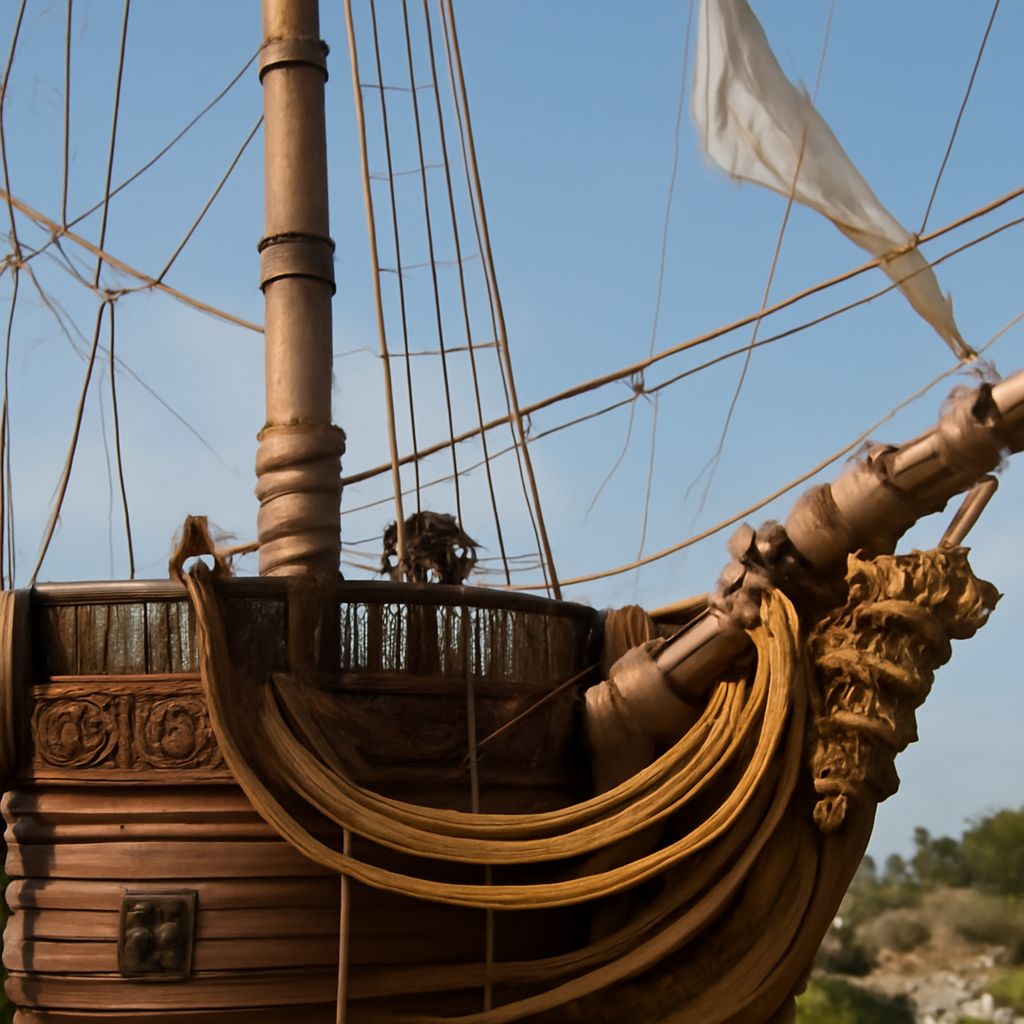
Queen Anne’s Revenge stands as one of the most iconic pirate ships of the Golden Age of Piracy. Notorious for its association with Blackbeard, this vessel looms large in both maritime history and the popular imagination. The legend of Queen Anne’s Revenge is as much a story of naval dominance as it is a tale of bold artistry and enduring myth. This article examines the ship’s remarkable rise, its infamous captain, the truth behind its claim to being the biggest pirate ship, and its lasting influence on art and culture.
The Rise of Queen Anne’s Revenge
The ship that would become Queen Anne’s Revenge began her life far from the Caribbean seas. Originally built in 1710 in England and christened La Concorde, she was a French slave ship designed for long voyages and heavy cargo. In 1717, her fate changed dramatically when she fell into the hands of pirates off the coast of the West Indies. Blackbeard, whose real name was Edward Teach or Thatch, captured La Concorde and refitted her for piracy, renaming her Queen Anne’s Revenge. The name reflected the political turmoil of the era, echoing the recent end of Queen Anne’s War and hinting at a rebellious loyalty to the deposed Stuart monarchy.
Under Blackbeard’s command, Queen Anne’s Revenge was transformed into a pirate flagship. The refitting included mounting up to 40 guns, reinforcing the hull, and optimizing the rigging for speed and maneuverability—quite a departure from her original use as a merchant vessel. This made her a formidable opponent for both merchant ships and naval vessels alike. The ship’s intimidating firepower and size allowed Blackbeard to enforce blockades and stage daring attacks along the Atlantic seaboard and in the Caribbean.
Queen Anne’s Revenge quickly earned notoriety as a symbol of pirate strength. Her most infamous exploit occurred in 1718, when Blackbeard used her to blockade the port of Charleston, South Carolina—a brazen move that underscored the ship’s strategic importance and the audacity of her crew. Yet, her reign was brief: not long after, she ran aground on a sandbar near Beaufort Inlet, North Carolina. Whether this was due to navigational error or deliberate sabotage remains debated among historians, but the event marked the end of her short, violent career on the high seas.
Blackbeard and the Era of Pirate Ships
Blackbeard’s name is inextricably linked with Queen Anne’s Revenge, and the ship’s legacy is tightly bound to his legend. Unlike many pirates who preferred smaller, faster vessels for stealth and speed, Blackbeard’s choice of such a large ship set him apart. His imposing figure, complete with smoking fuses woven into his beard during battle, only heightened the terror inspired by his flagship.
The early 18th century saw the rise of many formidable pirate vessels, but few rivaled Queen Anne’s Revenge in reputation. Pirate captains of the era often sought out captured ships that could be refitted for their unique needs—balancing speed, cargo space, and, most crucially, firepower. Blackbeard’s approach was to maximize intimidation: with a crew of over 300 men and up to 40 cannons, Queen Anne’s Revenge was an unmistakable threat even to well-armed navy ships.
What made Blackbeard so effective was his psychological warfare. Merchants who faced Queen Anne’s Revenge frequently surrendered without a fight, wary of facing both the legendary captain and the overwhelming size of his ship. The vessel’s presence altered trade routes and prompted colonial governments to invest in more robust anti-piracy measures, illustrating the far-reaching influence of Blackbeard and his ship on maritime policy.
Other pirate ships of the time, such as Bartholomew Roberts’ Royal Fortune or Charles Vane’s Ranger, garnered their own fame. However, none achieved quite the same notoriety as Queen Anne’s Revenge, due in large part to Blackbeard’s flair for the dramatic and the ship’s brief but explosive career.
Was Queen Anne’s Revenge the Biggest Pirate Ship?
The reputation of Queen Anne’s Revenge as the biggest pirate ship is debated among historians, but her size and firepower were exceptional for her time. Measuring approximately 103 feet in length and 24 feet in beam, and boasting up to 300 crew members, she was among the largest pirate vessels ever documented. Her armament of up to 40 guns made her a floating fortress—most pirate ships of the era carried fewer than 20 cannons.
Yet, the definition of “biggest” in pirate lore is nuanced. While Queen Anne’s Revenge was certainly one of the largest and most heavily armed pirate ships, a few other vessels came close in size or firepower. Some warships converted by pirates were similar or slightly larger, but lacked the notoriety or historical documentation that surrounds Queen Anne’s Revenge.
What set her apart was the combination of firepower, crew size, and the dramatic exploits that followed her career. Her ability to blockade ports and stand up to the military response of entire colonies cemented her reputation as a giant among pirate ships. It is this blend of physical scale and legendary status that justifies her frequent ranking as the biggest pirate ship in the popular consciousness.
Today, much of what we know about her size comes from the shipwreck discovered in 1996 near Beaufort Inlet, North Carolina. Archaeologists have corroborated historical records with recovered cannons, hull fragments, and artifacts, confirming the ship’s impressive dimensions and armaments.
Queen Anne’s Revenge in Art and Visual Culture
The image of Queen Anne’s Revenge looms large in the arts, inspiring generations of painters, illustrators, filmmakers, and storytellers. From 18th-century woodblock prints to contemporary movies and video games, the ship is a recurring symbol of piracy’s golden age. Her silhouette—broad-beamed and bristling with guns—appears in countless visual interpretations, often accompanied by the menacing figure of Blackbeard himself.
Modern depictions have only amplified her legend. Films and television series routinely feature Queen Anne’s Revenge as the archetype of the pirate ship: massive, menacing, and shrouded in myth. The shipwreck’s discovery and ongoing archaeological work have led to museum exhibitions, detailed models, and educational installations, further cementing her place in popular culture.
Artists continually reinterpret Queen Anne’s Revenge, blending historical accuracy with imaginative flair. Whether in children’s books, fine art, or digital media, the ship’s story is retold as a tale of adventure, rebellion, and the allure of the sea. The enduring fascination with Queen Anne’s Revenge ensures her legacy remains as vivid today as it was in Blackbeard’s time.
From her dramatic rise to her legendary exploits and lasting cultural impact, Queen Anne’s Revenge is more than a ship—she is an enduring icon of maritime history and artistry.