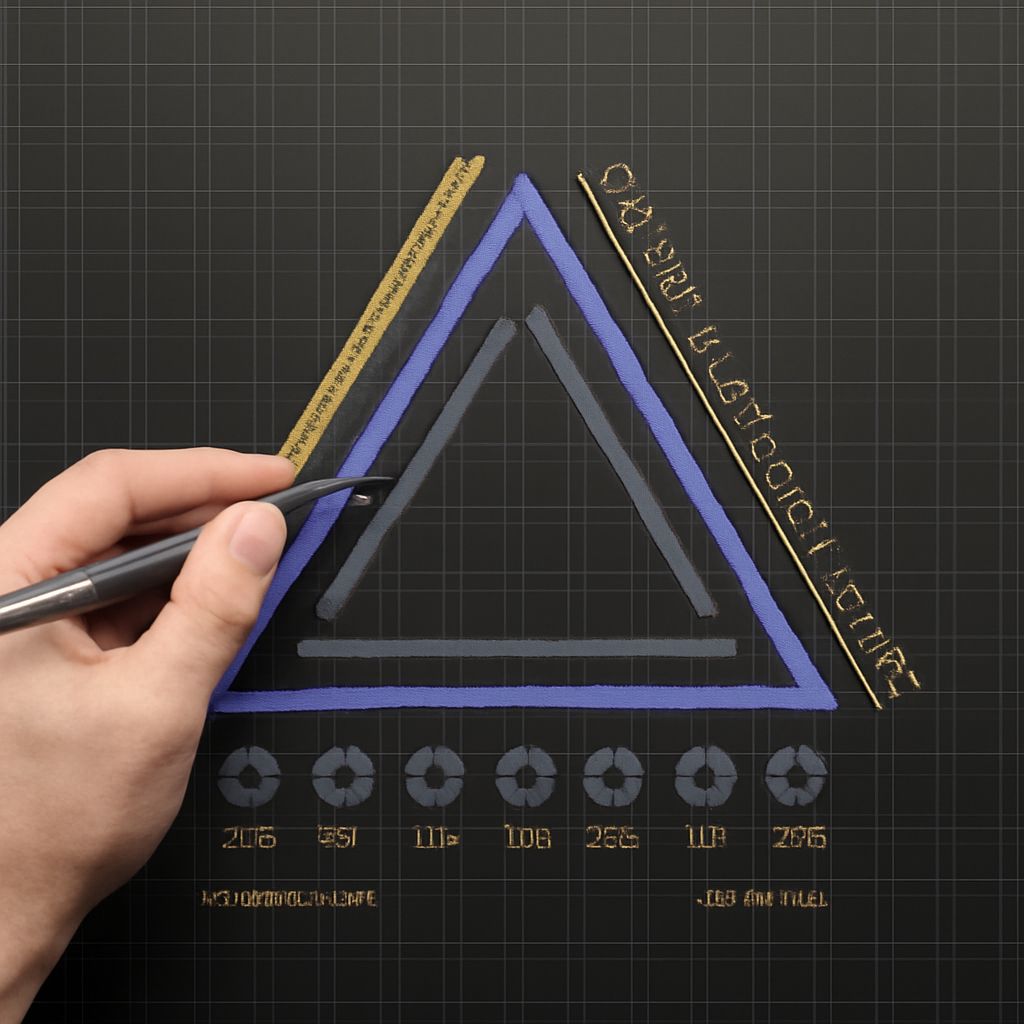
Camera anatomy is easiest to understand by tracing light. In a digital camera, the lens gathers and focuses light; the aperture limits it, the shutter times it, and the sensor records it. This sequence explains where each component sits and why settings change brightness, depth of field, motion, and noise.
The exposure triangle—ISO, shutter speed, and aperture—describes three controls that determine the recorded image. Aperture controls the opening, shutter speed controls duration, and ISO controls how strongly the sensor signal is amplified after capture.
Camera Anatomy: The Light Path from Lens to Sensor
Light first enters through the lens, which contains glass elements that focus rays onto the sensor. The lens also houses the aperture mechanism. Behind it, a digital camera may use a mirror and shutter curtains, depending on its design. Mirrorless cameras omit the reflex mirror, but the essential exposure path remains the same.
The shutter sits between the lens and sensor in many cameras. When it opens, light reaches the sensor for a measured interval. The sensor is a grid of photosites that converts incoming photons into electrical signals. The camera processor then turns those signals into an image file, which is written to the memory card.
Changing any stage affects the result. More light reaching the sensor usually produces a brighter image; less light produces a darker one. However, brightness is only part of the decision. The aperture changes focus range, the shutter changes how movement appears, and ISO changes signal strength and visible noise.
How Does Aperture Work? Blades and F-Numbers
Aperture blades overlap inside the lens to form a variable-sized opening, much like an adjustable pupil. A wide opening lets more light pass through, while a narrow opening lets less through. The opening also controls depth of field: a wide aperture such as f/2.8 can isolate a subject against a blurred background, while a narrow aperture such as f/11 keeps more of a scene acceptably sharp.
F-numbers describe the opening relative to the lens’s focal length, so a smaller number means a larger opening. Each full-stop change approximately doubles or halves the light reaching the sensor. Moving from f/4 to f/2.8 admits roughly twice as much light; moving from f/4 to f/5.6 admits roughly half as much.
The blades may form a round or polygonal opening. Their shape can influence the appearance of out-of-focus highlights, while the selected f-number determines the main exposure and depth-of-field trade-off. Focus distance and focal length also affect how much of the scene appears sharp.
Shutter Speed and ISO: Time, Signal, and Image Trade-Offs
Shutter speed determines how long the sensor collects light. A fast setting such as 1/1000 second can freeze a runner or flying bird. A slower setting such as 1/30 second records movement as blur and increases the risk of blur from camera shake. A tripod can reduce camera movement, but it cannot freeze a moving subject.
ISO does not create more light in the scene. Instead, it increases the amplification applied to the sensor’s captured signal. Raising ISO helps produce a usable exposure when aperture and shutter speed cannot provide enough signal, but it can also make noise more visible and reduce the clean detail or dynamic range available in the file.
For example, ISO 100, f/4, and 1/125 second may produce a suitable exposure. ISO 100, f/2.8, and 1/250 second can be approximately equivalent in brightness: the wider aperture adds one stop of light while the faster shutter removes one stop. The result has shallower depth of field and less motion blur.
Balancing ISO, Shutter Speed, and Aperture
Choose the setting that protects the visual quality most important to the photograph. For a portrait, begin with the desired aperture, then select a shutter speed fast enough to prevent subject movement and adjust ISO as needed. For sport, prioritize a fast shutter speed; use a wider aperture or higher ISO to compensate. For a landscape, a narrow aperture may be useful, with shutter speed supported by a tripod if necessary.
Consider another equivalent exposure: f/5.6, 1/60 second, and ISO 100 can be close in brightness to f/4, 1/125 second, and ISO 100. The first combination gives more depth of field but risks motion blur; the second better controls movement but blurs the background more. If the scene is too dark for either choice, raising ISO from 100 to 400 adds two stops of amplification, allowing a faster shutter or narrower aperture while increasing the possibility of noise.