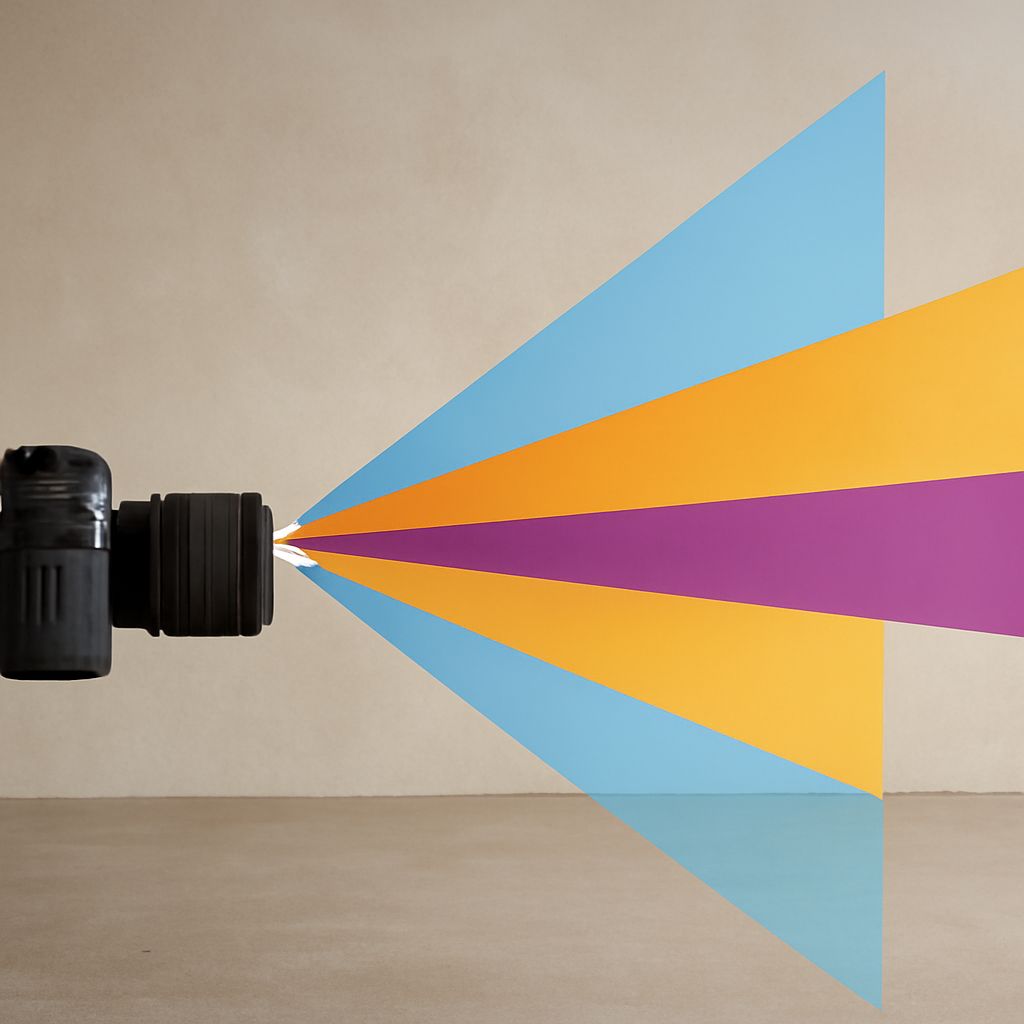
Image sensor size, ISO, and focal length work together: sensor format controls angle of view, crop factor, and light-gathering potential; ISO controls gain applied to the signal; and focal length controls framing. A larger format often delivers cleaner files and more highlight latitude, while a smaller format can make compact telephoto and wide-angle designs easier.
Using full frame as the reference, APS-C is about 1.5×, Micro Four Thirds 2×, and 1-inch about 2.7×. These factors let you compare actual lenses and full-frame-equivalent fields of view without confusing the lens’s physical focal length.
Image Sensor Size: Compare Common Formats and Crop Factors
- Full frame: Approximately 36 × 24 mm, with a 1× crop factor. It offers strong low-light performance and easier shallow-depth-of-field effects.
- APS-C: Approximately 23.5 × 15.6 mm, with a 1.5× crop factor. It balances image quality, camera size, and reach.
- Micro Four Thirds: Approximately 17.3 × 13 mm, with a 2× crop factor. Its compact lenses and deeper depth of field suit travel, wildlife, and video.
- 1-inch: Approximately 13.2 × 8.8 mm, with a 2.7× crop factor. It supports very compact cameras, though noise usually appears sooner in dim scenes.
Crop factor describes the narrower angle of view produced by a smaller sensor compared with full frame. Multiply a lens’s actual focal length by the crop factor to estimate its full-frame-equivalent view. Crop factor does not change the physical focal length printed on the lens, its optical construction, or its aperture marking.
ISO Cheat Sheet: Sensitivity, Noise, and Dynamic-Range Trade-Offs
ISO is a sensitivity or gain setting. Raising it amplifies the captured signal so you can use a faster shutter speed or smaller aperture, but it does not add light to the exposure. Each one-stop increase doubles amplification: ISO 400 is one stop faster than ISO 200, and ISO 800 is one stop faster than ISO 400.
- ISO 100–200: Best in bright light or with a tripod. It normally preserves the most dynamic range and the cleanest fine detail.
- ISO 400–800: A practical range for shade, overcast conditions, and general handheld photography.
- ISO 1600–3200: Useful for indoor subjects, events, and moving people. Expect some loss of shadow detail and visible grain, especially on smaller formats.
- ISO 6400 and higher: Suitable when motion blur would be worse than noise. Expose carefully because bright areas can clip and aggressive noise reduction can soften detail.
Actual native ISO ranges vary by camera, but the trade-off is consistent: use the lowest ISO that supports the required shutter speed and aperture. Larger sensors often tolerate higher ISO better, although pixel design, processing, and exposure accuracy also matter.
Lens Focal Length Comparison: Actual and Full-Frame-Equivalent Framing
A lens’s actual focal length is an optical measurement. Equivalent focal length only translates its angle of view to a full-frame reference.
- Wide view: 24mm on full frame, about 16mm on APS-C, 12mm on Micro Four Thirds, or 9mm on 1-inch.
- Normal view: 50mm on full frame, about 33mm on APS-C, 25mm on Micro Four Thirds, or 18mm on 1-inch.
- Short telephoto: 85mm on full frame, about 56mm on APS-C, 42.5mm on Micro Four Thirds, or 31.5mm on 1-inch.
These rounded examples produce a similar angle of view, not identical optical behavior. At the same f-number and framing, smaller formats generally show more depth of field; larger formats make background separation easier. Perspective depends on camera position, not on the focal-length number alone.
Equivalent Field of View Across Formats: Same Angle, Different Lenses
To reproduce roughly a 50mm full-frame view, choose a 33mm lens on APS-C, a 25mm lens on Micro Four Thirds, or an 18mm lens on a 1-inch camera. A 35mm APS-C lens therefore behaves like a 52.5mm lens in field-of-view terms, while its physical focal length remains 35mm.
For practical lens selection, convert the view first, then compare aperture, size, stabilization, and ISO needs. A smaller format may provide the desired reach with a lighter lens and more depth of field. A larger format may justify its size when cleaner high-ISO files, stronger shadow recovery, or pronounced background blur matter more.