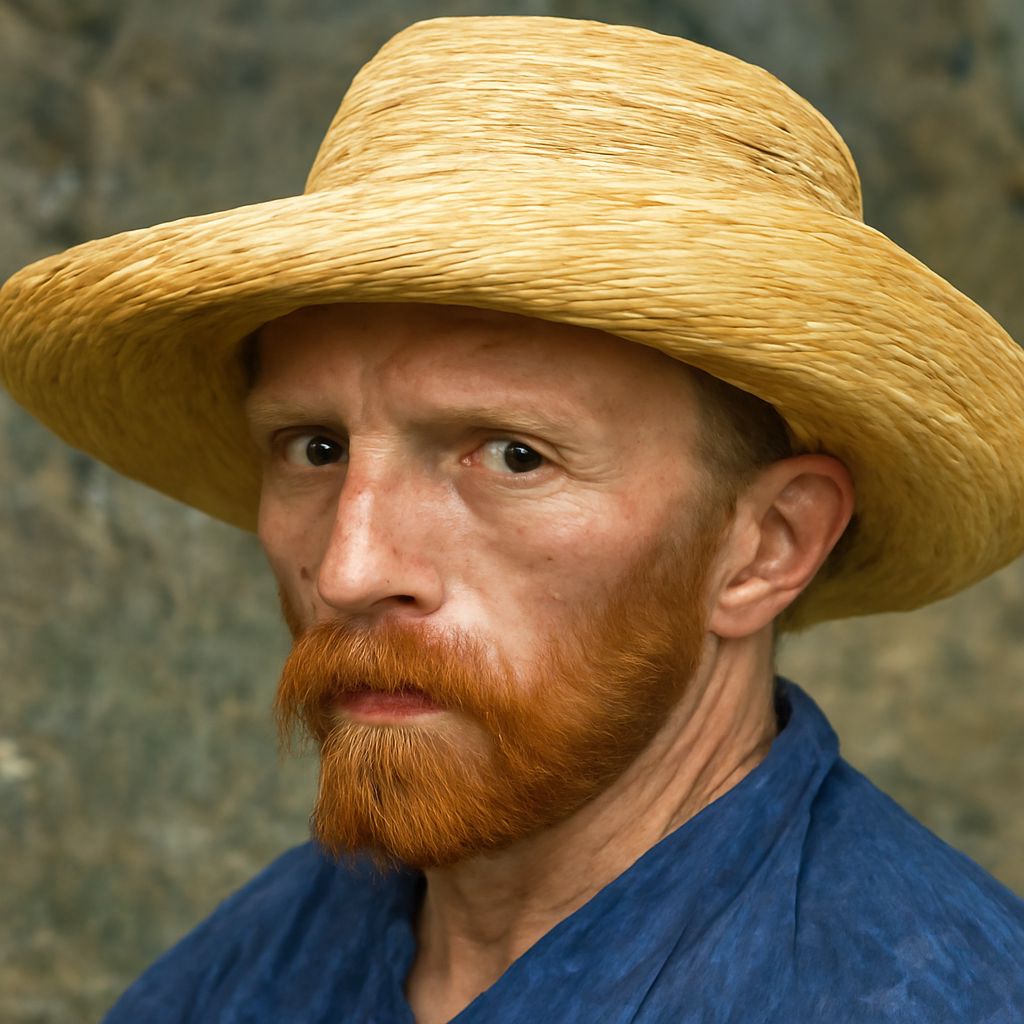
Portrait painters create likeness through more than accurate features. Drawing establishes proportion, value organizes the face, and color, edges, and brushwork determine whether a sitter appears calm, dramatic, distant, or intensely present. Van Gogh’s 1887 self-portrait shows how visible technique can become part of the subject’s character.
The painting is especially useful for studying how a portrait moves beyond description. Its blue-and-orange contrasts, directional strokes, and concentrated gaze make the act of painting visible while still preserving a convincing head and upper body.
Portrait Painters: Rembrandt’s Light, Velázquez’s Restraint, and Sargent’s Brushwork
Different portrait painters prioritize different kinds of presence. Rembrandt used strong light against shadow to direct attention toward the eyes and model a face with psychological depth. His warm, layered surfaces often make age, skin, and fabric feel materially present.
Diego Velázquez favored restraint. His economical transitions, subdued colors, and open, atmospheric brushwork suggest form without describing every edge. The result is a portrait that feels observed rather than over-explained.
John Singer Sargent made brushwork itself a source of energy. He could imply a sleeve, cheek, or glossy surface with a few decisive strokes, varying between polished passages and visibly abbreviated marks. These approaches show that likeness can come from lighting, omission, or handling rather than detail alone.
Core Portrait Painting Techniques: Drawing, Value, Color, Edges, and Brushwork
Effective portrait painting techniques work together. A painter can use the following sequence to analyze or construct a face:
- Drawing: Establish the head’s tilt, the centerline of the face, eye spacing, nose length, and the relationship between the features. A small error in the underlying structure can weaken an otherwise sophisticated painting.
- Value structure: Reduce the face to light, middle, and dark masses before chasing color. The shadow under the brow, the side plane of the nose, and the jaw shadow help turn a flat outline into modeled form.
- Color: Treat skin as a changing arrangement of warm and cool notes, not a single flesh tone. Reflected color from clothing or the background can alter the apparent temperature of the face.
- Edges: Use sharp edges where attention should settle, such as around an eye, and softer or lost edges where the form turns away. Uniform outlines make a portrait look cut out.
- Brushwork: Match the stroke to the form. Strokes that follow the cheek, forehead, or hair can reinforce volume, while contrasting directions can add agitation or visual rhythm.
Van Gogh’s 1887 Self-Portrait: A Case Study in Gaze and Form
Van Gogh painted several self-portraits in 1887 while living in Paris. This analysis focuses on the work commonly identified as Self-Portrait (1887), recognized for its blue-and-orange palette and lively, exposed brushwork. The Paris setting matters: Van Gogh was responding to Impressionist color and the broken handling associated with contemporary painting, while developing a more personal intensity.
The face is built from compact strokes rather than smooth blending. Orange and reddish marks animate the beard, cheeks, and hair, while blue and green notes cool the shadows and clothing. These oppositions do not merely decorate the surface. They separate planes of the head and make the face appear to vibrate against its background.
The background is active rather than neutral. Repeated strokes create a field of movement around the head, so the sitter seems embedded in the painting’s energy. Direction also matters: marks across the face describe changing planes, while surrounding strokes establish a visual pulse that keeps the eye moving.
Van Gogh’s gaze remains the anchor. The eyes are more controlled and concentrated than the surrounding paint, creating direct psychological contact. Although the beard, jacket, and background are vigorously handled, the facial structure remains legible. Value shifts around the eye sockets, nose, and jaw preserve modeled form beneath the expressive surface.
What the Case Study Reveals About Portrait Choices
Van Gogh’s portrait demonstrates that every formal decision carries expressive weight. A restrained painter may soften edges to suggest reserve; a painter like Sargent may use a single quick stroke to imply confidence; Van Gogh uses contrasting color and repeated directional marks to suggest alertness and inner pressure.
For a practical study, first map the head with simple values, then identify the warm-cool pattern, the sharpest edges, and the directions of the brushstrokes. Ask what each choice does to the gaze and the sense of form. In this case, technique does not sit on top of character: it is how character becomes visible.