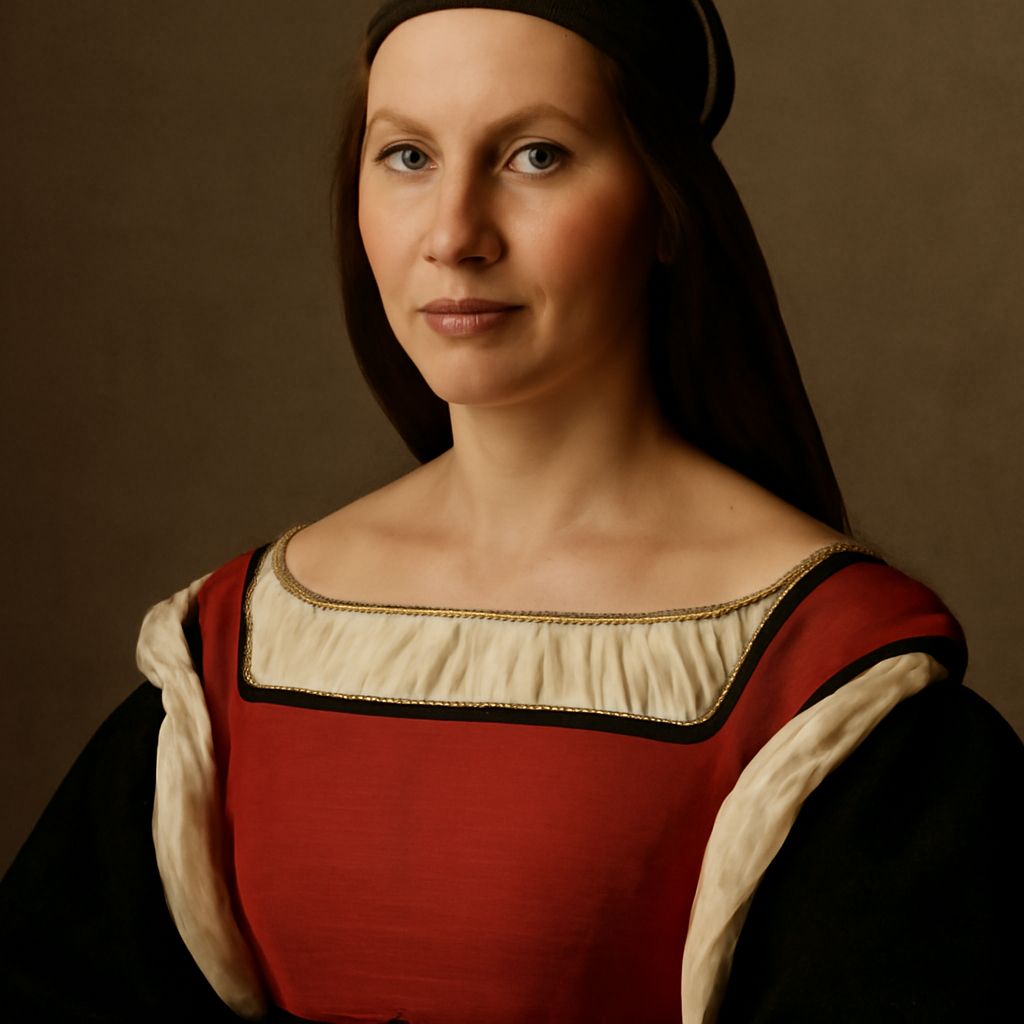
Portrait paintings of women are defined not only by recognizable features, but by the visual choices that establish a sitter’s identity and presence. Pose, gaze, setting, clothing, scale, and brushwork can present her as an official figure, a private individual, a symbolic subject, or an artist directing attention toward herself.
Velázquez’s court portraits, Berthe Morisot’s domestic scenes, and Frida Kahlo’s self-portraits demonstrate how the same basic subject can produce very different meanings. A formal composition tends to organize the viewer’s attention around status and display; a personal one may emphasize mood, intimacy, or the sitter’s control over how she is seen.
Portrait paintings: What makes a woman’s image a portrait?
A painted portrait of a woman usually combines likeness with interpretation. Facial features matter, but so do the decisions surrounding them: whether the body faces forward or turns away, how much of the figure is shown, and whether the background identifies a social role or removes distractions.
In a formal portrait, the sitter may be centered, upright, and carefully arranged. A column, curtain, architectural interior, or richly furnished room can frame her as powerful or well connected. A smaller domestic portrait may use a relaxed pose, an ordinary room, and softer edges to suggest familiarity rather than ceremony.
Portraiture therefore sits between record and invention. Even a restrained image selects an expression, costume, light, and moment. The result tells viewers how the sitter was presented, how the painter understood her, and sometimes how she wanted to be remembered.
The female portrait: Pose, gaze, and sitter agency in formal and informal examples
Pose is one of the clearest signals of status. A seated figure with an erect back and controlled hands can project authority, while a standing figure with one hand resting on a table may claim space and stability. In informal representations, crossed arms, a lowered shoulder, or a body turned toward another person can create a sense of lived time rather than public display.
Gaze changes the relationship with the viewer. A direct look can be commanding, resistant, confident, or simply attentive. It makes the viewer part of the encounter. Averted eyes may suggest modesty, thought, social convention, or concentration, but they do not automatically mean passivity. The surrounding pose and setting determine the reading.
Consider the difference between a court sitter presented frontally in jewels and a woman shown reading or dressing in a private interior. The first image may emphasize rank through controlled stillness; the second may imply an identity beyond public office. Agency appears when the sitter seems to occupy the pose deliberately rather than merely endure it. Direct eye contact, an unyielding posture, self-possession, or an active task can all make that control visible.
Setting, clothing, and symbolic detail in court and domestic portraits
Setting supplies social information. Court portraits use palaces, formal gardens, attendants, heraldic objects, or luxurious furniture to locate a woman within systems of power. Velázquez’s portraits of the Infanta Margarita Teresa, including Infanta Margarita Teresa in a Blue Dress, use elaborate dress and composed stillness to communicate dynastic importance as well as childhood.
Domestic portraiture shifts emphasis toward relationships and routine. In Berthe Morisot’s The Cradle, the intimate interior and quiet exchange between the figures create a maternal scene rather than a public declaration. The setting does not erase identity; it frames the sitter through care, family, and daily life.
Clothing can reinforce or complicate these readings. A crown, lace, military decoration, or jeweled fabric announces rank, while plain clothing may signal privacy, modernity, work, or artistic seriousness. Objects can act as symbols: books suggest learning, flowers may imply beauty or mortality, and mirrors can raise questions about self-image and observation. These meanings remain flexible because color, placement, gesture, and the sitter’s expression modify them.
Woman portrait styles: From Velázquez and Morisot to Kahlo’s self-portraits
Style determines how visibly the painter’s hand participates in the sitter’s identity. Velázquez often uses controlled composition and subtle changes in paint to give court subjects both ceremonial presence and psychological complexity. The surface supports status, yet the expression can remain open-ended rather than merely decorative.
Morisot’s impressionist handling is lighter and more visibly atmospheric. Broken brushwork, pale color, and shifting light make domestic portraiture feel immediate. Her women are not simply presented for inspection; they inhabit rooms, relationships, and moments that resist the stiffness of official display.
Kahlo’s self-portraits make authorship part of the subject. In Self-Portrait with Thorn Necklace and Hummingbird, the frontal pose and steady gaze confront the viewer, while the necklace, animals, foliage, and restrained expression create a dense symbolic field. Because Kahlo selects her own appearance and signs the image with her visual language, the portrait becomes self-definition as well as likeness.
Across these approaches, a woman portrait can be formal, domestic, symbolic, or self-directed. The most revealing comparison is not simply what the sitter wears, but who appears to control the image: the institution commissioning it, the painter interpreting it, the social setting surrounding it, or the woman claiming the viewer’s gaze for herself.